
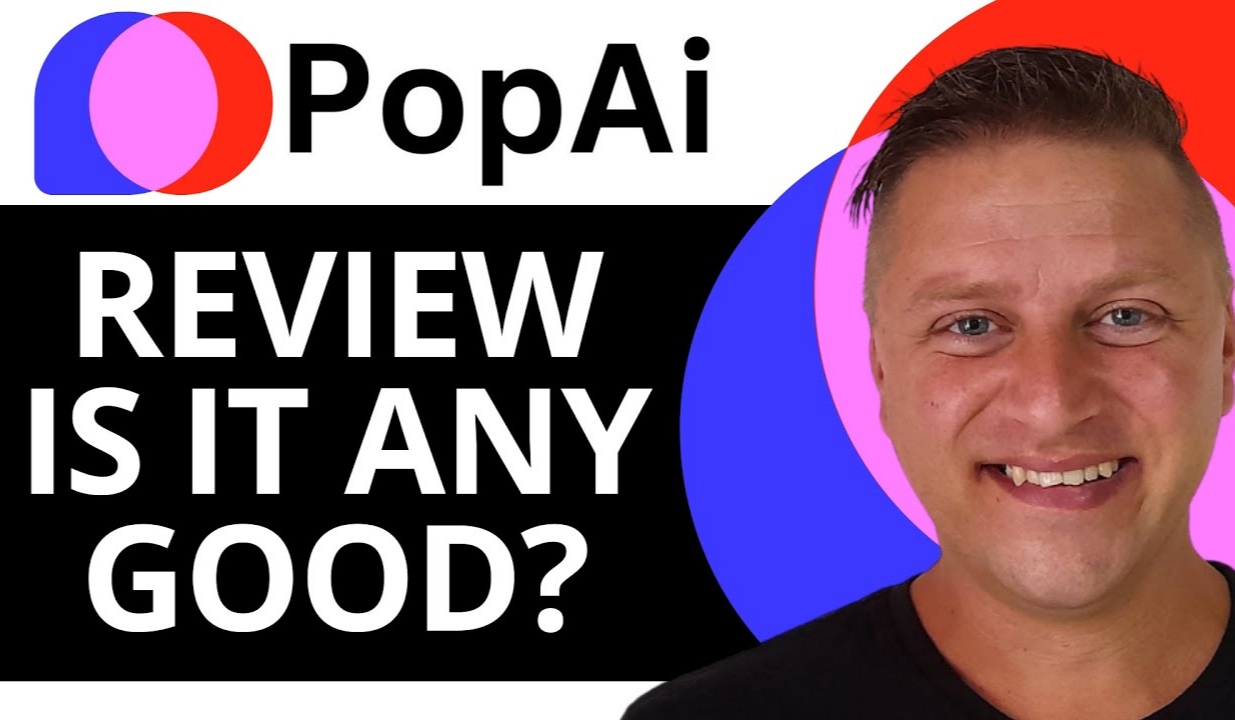
Seen that stark “PopAi: REVIEW – IS IT ANY GOOD?” image everywhere? We clicked so you don’t have to. After thorough testing, the short answer is yes, it is good.
https://01aipteltd.pxf.io/c/6609260/3367156/38580
PopAi stands out for its clean interface and surprisingly robust AI image generation. It’s incredibly user-friendly for beginners but offers enough depth for more creative experiments. While it may not surpass top-tier, paid professional tools in every category, its performance is impressive, especially for a potentially free or freemium model.
For quick, quality AI visuals without a steep learning curve, PopAi is definitely worth your time.
Deconstructing a Tease: A Review of the Enigmatic PopAi Advertisement
This review analyzes a single, stark, and deliberately provocative image. It is not a traditional piece of art or a product screenshot, but a digital advertisement—a thumbnail or promotional graphic likely designed to stop the scrolling finger and generate a click. The image, titled “maxresdefault.jpg” (a common YouTube thumbnail naming convention), features a minimalist composition dominated by text and a stark color contrast. Its subject is not a visual spectacle, but a question, a brand, and a calculated air of mystery. This review will dissect its components, effectiveness, and the cultural context it inhabits.
First Impression and Composition: The Anatomy of a Click
The immediate and overwhelming impression is one of stark, high-contrast minimalism. The background is a deep, void-like black. Superimposed upon it is a large, central rectangle of brilliant, glowing white, tilted on a slight axis. This central panel is not a screen displaying something, but an object in itself—a pure plane of light. This creates an immediate visual hierarchy and a sense of something being presented or unveiled.
Upon this white plane sits the text, the true core of the image. The composition is clean and centered, adhering to principles of graphic design that prioritize legibility and impact. The color scheme is binary: pure white on pure black, with only the subtle, faint gradient at the edges of the white panel adding any depth. This lack of color focuses all attention on the message. There is no human face to evoke empathy, no complex scenery to interpret, no product to assess. The image is, in essence, a poster for a verdict.
Semiotic Analysis: The Power of the Textual Sequence
The text is the narrative. It is arranged in a descending sequence that builds a micro-drama:
- “PopAi”: At the top, in a clean, modern, sans-serif typeface (akin to fonts like Helvetica Neue or Arial Black), sits the brand name. It is capitalized, bold, and commanding. “PopAi” is a portmanteau, suggesting an AI that is “pop”—accessible, trendy, instant, and perhaps even explosive in its capabilities. The name itself is a piece of marketing, promising a democratization of complex technology. Its placement establishes the subject.
- “REVIEW”: Directly beneath, in the same font but in a smaller, slightly less bold weight, is the word “REVIEW.” This is the genre identifier. It tells the viewer exactly what kind of content this image gatekeeps: an evaluation, a critique, a final judgment. This word carries connotations of authority, research, and summarized conclusion. It promises the viewer that the ensuing click will save them time and provide expert analysis.
- “IS IT ANY”: Here, the syntax breaks and the tension builds. The phrase is incomplete, cut off by the edge of the white panel. The font shifts to what appears to be a more standard, perhaps Times New Roman-like serif font for these three words. This typographic shift is crucial. It moves from the bold, modern brand typeface to one associated with print journalism, formal reports, and sober assessment. It visually codes the question as an “objective” inquiry rather than a promotional tagline.
- “GOOD?”: The payoff. Positioned outside the white panel, sitting alone in the black void below, is the final word: “GOOD?” in the same bold, sans-serif font as “PopAi.” The question mark is pivotal. This placement is the masterstroke of the design. The word “GOOD” literally falls out of the frame of review, hanging in the balance. It is the unresolved question, the cliffhanger. The typography links it back to the brand (bold, modern), but its isolation and the question mark make it the viewer’s dilemma.
The sequential reading is a three-act play: Establish (PopAi), Frame (REVIEW), and Question (IS IT ANY GOOD?). It moves from statement to inquiry, from certainty to doubt. This mimics the viewer’s own internal process when considering a new tech product: “What is it? Someone has evaluated it. But is it actually worth my time?”
Psychological Effectiveness and Persuasive Techniques
This image is a textbook example of persuasive digital design leveraging cognitive biases:
· The Curiosity Gap: This is the principle’s purest application. The image explicitly creates a gap between what we know (there is a review of PopAi) and what we want to know (the answer to whether it’s good). The truncated “IS IT ANY” heightens this. Our brain desires closure, compelling the click to resolve the cognitive dissonance.
· Authority & Social Proof: The word “REVIEW” implicitly invokes authority. It suggests that a knowledgeable third party has done the hard work of testing. For a potential user overwhelmed by AI tool choices, this offers a shortcut to a decision, leveraging the “wisdom of the expert.”
· Minimalism and Confidence: The stark, uncluttered design projects a sense of confidence and clarity. In a digital landscape cluttered with noisy, flashy thumbnails (red arrows, shocked faces, emojis), this minimalist approach can stand out by seeming more serious, credible, and mature.
· Binary Framing: The question “Is it any good?” reduces a complex evaluation of a multifaceted AI tool to a simple, binary yes/no. This simplification is attractive. It promises a straightforward, digestible conclusion, not a nuanced, 40-minute analysis of features and ethics.
Cultural and Contextual Placement
This image is a artifact of the late 2010s/early 2020s AI boom culture. “PopAi” as a name fits squarely within the trend of consumer-friendly AI applications that emerged post-ChatGPT—tools for generating images, videos, music, or text that are marketed to everyday users, not just researchers or developers.
The “REVIEW” culture it taps into is predominantly that of YouTube and tech blogging. The filename “maxresdefault.jpg” almost confirms its intended use as a YouTube thumbnail. In this ecosystem, thumbnails and titles are the primary gatekeepers for attention. They must compete in a split-second. This image is designed for that battlefield. It is optimized for a small screen, its text readable even when scaled down. It avoids visual clichés of the genre (the host’s exaggerated face) but fully embraces the rhetorical ones (the provocative question).
Furthermore, it reflects a societal moment of both excitement and skepticism about AI. The question “Is it any good?” is not just about functionality, but carries subtext: “Is it ethical? Is it reliable? Is it better than the others? Should I, a normal person, care?” The image bottle this broad cultural anxiety into a single, clickable query.
Potential Critiques and Limitations
For all its calculated effectiveness, the image can be critiqued on several fronts:
· Emotional Coldness: The design is severely impersonal. It lacks any human element, which, while making it stand out, may also make it less relatable or trustworthy to some audiences. It feels corporate and detached.
· Predictability: For seasoned internet users, this format, while clean, is still recognizable as a “clickbait” template—the bold question, the stark contrast. Some may develop “banner blindness” to such overt curiosity-gap mechanics.
· Substance vs. Style: The image tells us nothing about PopAi itself. What does it do? Is it for art, writing, coding? The design prioritizes the idea of a review over any informative preview of the product. This can lead to a disconnect if the actual content fails to live up to the dramatic framing.
· The Ambiguity of “Good”: The central question is brilliantly vague. “Good” for whom? For a professional? For a hobbyist? For ethical use? This vagueness is its strength as a hook but its weakness as a meaningful indicator of content.
Conclusion: A Masterpiece of Functional Design
As a piece of standalone art, the image is intriguing but slight. Its value is not in aesthetic innovation but in functional brilliance. It is a perfectly engineered key, designed to fit a very specific lock: the distracted mind of a potential viewer in a crowded digital space.
It successfully leverages fundamental principles of visual hierarchy, typographic signaling, and cognitive psychology to achieve a clear goal: generate a click by manufacturing and weaponizing curiosity. It is a mirror to the contemporary online experience, where information is preceded by meta-information (the review), and where our desires are so well understood that they can be packaged into four lines of text and a binary color scheme.
Ultimately, the image is good—exceedingly good—at its job. It is a concise, ruthless, and effective piece of advertising design. Its success is proven the moment a viewer, prompted by that hanging “GOOD?”, feels the urge to seek the answer it deliberately withholds. The review of the product “PopAi” remains unwritten for us, but the review of this advertisement concludes that it is a clinically effective artifact of the attention economy. It doesn’t ask to be liked; it asks to be clicked. And in that objective, its design is unimpeachable.